

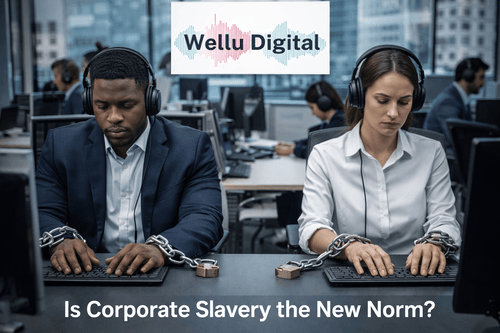
For decades, the corporate job was pitched as the ultimate success. A solid pay cheque, office life, career progress, and financial stability were the ideal road to a successful existence. For many, embracing corporate life brought stability, respect, and professional accomplishment.
But in recent years, a new discourse has begun to emerge online and in workplaces around the world.
More workers are speaking up about whether modern company culture is turning harmful. So many professionals have described their experience with one problematic phrase: long working hours, continual pressure, emotional tiredness, high expectations, and the inability to unplug from work.
That might sound excessive, but the rise of the phrase is a symptom of a deeper discontent with modern work culture. The main question is not whether the jobs are actual slavery. They aren’t.
The underlying question is why so many employees feel emotionally bound, cognitively weary, and unable to break free from systems slowly destroying their welfare.
The Emergence of the Term “Corporate Slavery”
The word caught on because many employees believe the current work culture demands more than just productivity.
For many professionals, work doesn’t cease when the office hours are finished.
Employees will:
- Respond to emails after work
- Be available on weekends
- Satisfy impossible deadlines
- Continuous improvement of performance
- Manage growing workloads
- Work productively under pressure
This, over time, produces a perception that life is all about work.
People start sacrificing:
- Time for me
- Psychological health
- Familial connections
- Sleep and rest
- Well-being (Physical)
- Interests and social life
The resentment only builds when workers discover that even when they work harder, they still feel financially pressured, emotionally drained, or professionally interchangeable.
This imbalance of emotion is one reason why the phrase “corporate slavery” resonates with so many people today.
Hustle Culture Makes Exhaustion The Norm
The growth of hustle culture is one of the main drivers of poisonous corporate culture. In our modern world, overworking is often glorified.
People are commended for:
- Working late at night
- Fewer hours of sleep
- Constantly on the go
- Giving up personal life for achievement
- Being available around the clock
Burnout is sometimes seen as a badge of ambition. Rest is seen as sloth. It’s easy to feel guilty about taking time off. Employees tend to feel valued only for their output.
This creates a vicious loop where people keep pushing themselves when they are psychologically and physically weary. Over time, life is no longer a part of work, but work itself.
Employees Feel More Replaceable
Employees Feel More Replaceable Than Ever Before. Another factor in people feeling estranged from corporate culture is the growing belief that firms view employees as replaceable resources rather than humans.
For many workers, such scenarios as:
- Fired after years of service
- Not appreciating extra work
- No emotional support from management
- The pressure to always be overachieving
- Lack of work-life balance
This results in emotional disconnect. Workers start to see that giving up their health and personal happiness does not necessarily result in stability or recognition.
So, many professionals are now asking, “Does corporate loyalty still matter?”
Technology Increased Work-Related Stress
Work was meant to be made easier by technology. It has, in many ways. But it also fostered a culture in which staff are reachable at all hours.
Phones, messaging applications, emails, and remote work tools have blurred the line between work and home life. Now, many workers feel the need to be connected outside of working hours.
The modern workplace today has the following expectations:
- Immediate answers
- Availability 24/7
- Increased productivity
- Continuous multitasking
- Handling work outside of office hours
The upshot is that many never quite unplug psychologically from work. Even at home, work is upon them.
Corporate Environment and Mental Health Expenses
Mental health issues are perhaps one of the largest problems related to modern business life.
High-pressure conditions often contribute to:
- Anxiousness
- Burn out
- Prolonged stress
- Burnout
- Sleep difficulties
- Indicators of depression
Many professionals feel caught between financial duties and emotional welfare.
Theoretically, leaving a toxic workplace is easy. In reality, people have bills, families, loans, and responsibilities. This means that workers continue to tolerate toxic settings because they are afraid that their financial survival is more essential than their peace of mind.
Why More Are Leaving Traditional Corporate Culture
Younger generations are beginning to go in a different direction. Many professionals no longer feel it’s worth sacrificing health and pleasure for work prestige.
People are now more interested in:
- Flexible working settings
- Mental well-being
- Work-life balance
- Opportunities for remote work
- Personal liberty
- Working with a purpose
That’s why freelancing, remote business, entrepreneurship, and digital occupations are increasingly enticing.
Salaries aren’t the only thing employees are looking for anymore. They are looking for control of their time and life.
Are Corporations Always Toxic?
Not all corporate workplaces are bad. There are a lot of firms that actually care about their people, care about mental health, care about balance, and have good company cultures.
The problem is not the corporate work. The problem starts when productivity is valued above individuals.
Generally, healthy workplaces offer:
- Respecting personal boundaries
- Reasonable workloads
- Leadership support
- Opportunities for recognition and growth
- Realistic expectations of realism
- Assistance with work-life balance
Employees perform better when they feel respected, not continually pressured.
Conclusion
The term “corporate slavery” gained popularity because many employees feel emotionally strained, cognitively weary, and estranged from the life they seek outside of work.
“People aren’t rejecting hard work.”Most people know that to be successful, you have to work at it and have discipline. They’re wondering if today’s corporate culture has blurred the line between ambition and a sick preoccupation with productivity.
Work should not be life-consuming, but life-supporting. Maybe the growing anger about corporate culture has nothing to do with laziness or entitlement.
Maybe people are just realising that success isn’t worth much if it costs you your serenity, health, and happiness.
For more insights, visit WellU Digital