
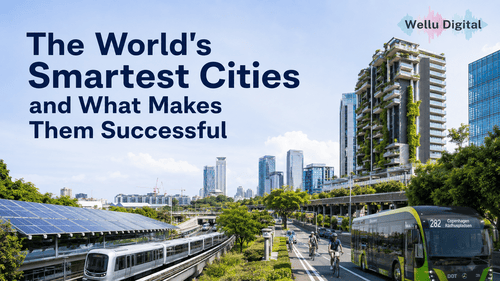
The rise of cities worldwide presents several challenges in transportation, sustainability, public safety, housing, and infrastructure. Many governments are tackling these difficulties through investments in technology-driven solutions that can enhance the quality of life for inhabitants and make cities more efficient, sustainable, and connected.
This has given rise to the concept of smartest cities.
The idea of a smart city is a city that leverages technology, data, and innovation to improve the quality of life of the city. Smart traffic systems, renewable energy projects, digital government services, and AI-driven infrastructure are among the ways smart cities are transforming how modern civilisations work.
But what are the best cities in the world?
Technology is not the answer. Successful smart cities combine innovation, sustainability, excellent governance, and citizen-centric planning to create environments where people live, work, and flourish.
What is a Smart city?
A smart city is an urban area that leverages digital technologies and data-driven solutions to improve public services, infrastructure, transit, environmental sustainability, and quality of life.
The smart cities are as follows: –
- Intelligent Transportation Systems
- Green energy options
- E-Government Services
- Better waste management
- improved communication systems
- Data-driven urban planning
- Improved public safety
The goal is to build cities that are not just smarter, but also more habitable, more efficient and more environmentally responsible.
Why do we need smart cities now?
Urbanisation is happening at an unprecedented rate. More and more people are migrating into towns and cities, placing enormous strain on infrastructure and public services.
Smart city programs seek to address problems such as:
- Traffic congestion
- Air pollution
- Energy consumption
- Inefficiencies in public transport
- Population growth
- Controlled resources
Technology can help cities make better decisions, save money, and improve the quality of life for residents.
1. Singapore: The Global Leader in Smart Urban Development
Singapore is typically seen as one of the most sophisticated smart cities globally.
Technology has been woven into just about every facet of city-state life, from transit to health to public safety to environmental control.
Why is Singapore successful?
- Digital infrastructure around the country
- Intelligent Traffic Management Systems
- AI in Urban Planning
- Good public transit connections
- Innovation support from the government
- Smart Health Projects
Singapore is the most intelligent city in the world, and it integrates technology well into daily life. It provides great public services.
2. Copenhagen: At the forefront of sustainability
Copenhagen has laid claim to the smart city title when it comes to sustainability and environmental stewardship.
It’s not just about the technology; the city connects innovation to hard climate targets.
Success Factors include
- Extensive cycling infrastructure
- Smart grids
- Investment in renewable energy
- Smart Waste Management Systems
- Urban Planning by Citizens
- Green Building Initiatives
For example, Copenhagen shows that a successful smart city is not only about digital change, but also about a healthy and sustainable urban environment.
3. Tokyo: Large Innovation
Tokyo is one of the largest cities in the world and a pioneer in technical innovation.
With millions of people, you really need efficient systems to support transit, communication, public services, etc.
Why Tokyo Is Different
- Advanced public transit systems
- Intelligent infrastructure investments
- Technologies for disaster preparedness
- Robotics integration
- Quick links
- Technology is constantly innovating
Tokyo is a good example of how smart city ideas can be utilised in a very crowded urban area.
4. Amsterdam: Building a Smart City for the People
Amsterdam is known for its collaborative approach to building smart cities.
Amsterdam is waiting for government initiatives but is also actively engaging companies, researchers, and citizens in pushing urban innovation.
Key strengths include
- Open data projects
- Intelligent Transportation Projects
- Vert Transportation
- Communities with energy efficiency
- Public-private cooperation
- Community-driven innovation
Amsterdam’s success highlights the need for citizen involvement in building smart cities that work. 5. A case of digital transition: Seoul
Seoul is at the forefront of the globe in terms of digital governance and IT infrastructure.
The city employs cutting-edge technologies to enhance public services and ensure a smooth experience for its residents.
5. Seoul: A Digital Transformation Success Story
- Fast Internet connection
- E-government services
- Smart public transport
- Heightened security and surveillance systems
- Smart city urban planning
- A robust innovation ecosystem
Seoul is a good example of how the digital transformation may make public services more efficient and accessible.
6. Zurich: The Conflict Between Innovation and Quality of Life
Zurich consistently ranks as one of the world’s brightest cities, with a strong focus on sustainability, innovation, and public wellbeing.
Key Success Factors
- Public transport good and easy
- Renewable energy schemes
- Intelligent utility management
- Strong digital infrastructure
- Quality of public services
- Investment in research and innovation
Zurich demonstrates that a smart city thrives on a high quality of life, not merely on technology.
Common Characteristics of the World's Smartest Cities
Although every smart city follows a unique strategy, the most successful examples share several important traits.
Strong Digital Infrastructure
Reliable connectivity is the foundation of every smart city. High-speed internet, communication networks, and data systems enable technology-driven solutions across various sectors.
Sustainable Urban Development
The best smart cities prioritize environmental responsibility through renewable energy, green transportation, and efficient resource management.
Efficient Public Transportation
Smart transportation systems reduce congestion, improve accessibility, and lower environmental impact.
Data-Driven Decision Making
Successful cities use real-time data to improve planning, optimize services, and respond quickly to emerging challenges.
Citizen-Centered Design
Technology is most effective when it improves people’s daily lives. Smart cities focus on solving real problems rather than adopting technology for its own sake.
Government Support and Innovation
Long-term success often depends on strong leadership, clear policies, and continuous investment in innovation.
Challenges Facing Smart Cities
Despite their advantages, smart cities also face important challenges.
Common concerns include:
- Data privacy and security
- High implementation costs
- Digital inequality
- Cybersecurity risks
- Infrastructure maintenance
- Balancing innovation with regulation
Addressing these challenges is essential for sustainable and responsible smart city development.
What Can Other Cities Learn From These Success Stories?
The world’s smartest cities show that technology alone is not enough.
Success comes from combining innovation with strong governance, sustainability, and a clear focus on improving residents’ lives.
Cities that prioritize:
- Long-term planning
- Digital transformation
- Environmental sustainability
- Public engagement
- Infrastructure investment
They are more likely to thrive in an increasingly urbanized world.
Final Thoughts
The world’s smartest cities are not simply the most technologically advanced. They are the cities that use innovation to create safer, cleaner, more efficient, and more livable environments for their residents.
From Singapore’s digital leadership and Copenhagen’s sustainability initiatives to Seoul’s advanced infrastructure and Amsterdam’s citizen-centered approach, these cities offer valuable lessons for urban development worldwide.
As populations grow and cities face new challenges, smart city strategies will play an increasingly important role in shaping the future of urban living.
For more insights, visit WellU Digital