
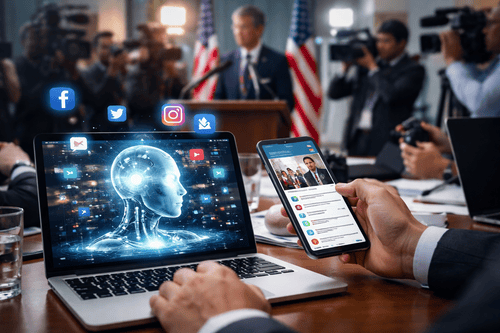
Technology is transforming how people communicate, make decisions, and interact with the public worldwide. Artificial Intelligence and social media have transformed the functioning of political campaigning, the spread of information, and the way citizens engage with the political ecosystem in recent years.Over the past few years, social media and artificial intelligence have had a profound effect on political campaigning, the dissemination of information, and citizen engagement with political concerns.
Digital technology has been part of the change in lifestyle all around the world due to the emergence of AI. The way individuals consume news, communicate, and discuss politics is vastly different now from what it used to be. Social media and AI-driven tools are major players in today’s political landscape.
The recent surge of the link and dependency of AI, social media, and politics may assist individuals in better comprehending the prospects and problems of digital political influence.
The Role AI Plays in Today’s Politics
AI is a term for a computer system capable of doing human functions such as data analysis, pattern recognition, and responding.
AI technologies are increasingly being applied to politics to:
- Analyzing voter behavior
- Enhance campaign tactics
- Keep tabs on public opinion
- Automate Your Communication
- Customize political messages
With the development in technology, the Role of AI in Politics has been expanding in several countries and political arrangements.
AI Changing Lifestyle and Political Participation
Digital technology is tied to the AI revolution that is changing lifestyles all over the world. People are very dependent on their smartphones, social media, and AI-based platforms for information and communication.
This has affected political engagement in several ways:
- It is easier to get political news.
- More political discussions on the Internet.
- Public response as it unfolds
- This means more digital engagement from younger audiences.
The stuff consumers see on the web is also influenced by AI algorithms, which shape their ideas, interests, and political awareness.
How Social Media is Shaping Modern Politics
Social media has had a much greater impact on politics over the past 10 years. Facebook, X, Instagram, YouTube, TikTok, and other platforms serve as avenues for politicians and political institutions to reach out directly to the people.
Direct Interaction with the Voters
Social media help political leaders:
- Share campaign messages
- Respond rapidly to public concerns
- Expand your audience
- Creating Political Profiles for Individuals
Social platforms allow you a direct link between politicians and the public that is impossible with traditional media.
Delivering Real-Time Information
News and announcements about political events spread swiftly online today and are accessible for debate.
Social media has impacted the ways of consumers to:
- Get the news
- Talk politics
- Talk to the community
- Coordinate and organize campaigns and actions
This makes it easier to acquire access, but also can help to propagate misinformation more quickly.
Develop AI-based Political and Campaign Strategies
AI in Politics has gained interest as campaigns want to understand voter behavior to inform data-driven strategies. In Politics, AI is becoming more and more common as campaigns try to understand voter behavior to develop data-driven strategies.
Analysis of Voter Data
AI systems can analyse large-scale information to discover:
- Voter choice
- Public worries
- Trends in engagement
- Regional interest politics
This information may assist campaign teams in formulating communication strategies that are specific to their needs.
Custom Political Ads
Artificial intelligence technology can help political campaigns deliver targeted adverts based on online activity and user behavior.
Some campaigns may tailor their messages according to:
- Age categories
- Hobbies
- Geographic location
- Social media interaction
This allows more targeted campaigns to certain target demographics.
The role of AI in Decision-making and Politics
AI in Politics is not only about campaigning. Governments, political organizations, and other institutions in the political space may potentially use AI systems to support administrative and policy-related tasks.
Policy Analysis
AI technologies can be used to analyse:
- Economic figures
- Public comment
- Social trends
- Infrastructure requirements
These tools can assist policymakers in reviewing the material easily and rapidly while processing massive amounts of data.
Tracking Public Opinion
Governments and political actors are also using AI technologies to track public sentiment on digital platforms and social media. Some governments and political institutions are using AI algorithms to track public opinion on social media and other digital channels.
This may help to find out:
- Public fears mounting
- Reactions to policy decisions
- Community priorities
However, privacy, transparency, and ethics issues are a major concern in the context of AI systems for public monitoring.
AI is changing politics with automation. How AI is transforming modern politics with automation
One such breakthrough is the automation and digital communication of AI in changing modern politics.
- Content Generation Automation
- AI tools are now capable of generating:
- Political speeches.
- Social media posts
- Campaign e-mails
- Public response
Automation can be considered a technique of improving efficiency, but it also brings the challenges of authenticity and disinformation into the process.
Chatbots and virtual assistants
Some political campaigns are using AI chatbots to reply to voters’ questions and provide information online.
These systems can:
- Speed up reaction times
- Make more accessible
- Increase voter turnout
But human intervention is still needed to communicate accurately and responsibly.
The Risk of Social Media and AI in Politics
There are benefits of technology, but also political aspects and concerns about digital safety.
Fake news and false content.
AI-generated material and viral social media can quickly spread misinformation and disinformation.
Possible dangers include:
- Deepfake video
- Photoshopped pictures
- Fake promises in politics
- Dishonest campaign advertisements
Such concerns can affect public faith and democratic behavior.
Political Polarization
Social media may favor engaging material, which can encourage more emotional or controversial political discussions.
This can help contribute towards:
- Political polarization
- Online aggression
- Reverberators
There was less variety of viewpoints.
The political context today continues to be crucial to digital communication and media literacy.
Privacy and Ethical Concerns
Moreover, the application of AI in politics also raises legal and ethical issues.
Concerns may be:
- Methods of data collection
- Targeted election advertising
- Explainability of AI systems
- Algorithmic bias
As governments, technology companies, and regulators debate how to govern AI responsibly in political institutions, its effect is being felt in business and life. Governments, technology corporations, and regulators continue to examine the impact of AI in business and life and how to handle it responsibly. Political systems are still debating that.
Positive Impacts of AI and Social Media in Politics
There are worries, but also good potential for political engagement and public interaction through technology.
Possible benefits include:
- More Voter Awareness
- Access to information should be easier.
- Emergency communications accelerated
- More political participation
- More effective public outreach.
Compared to before the introduction of digital platforms, digital platforms can facilitate the spread and engagement of information and community members in political conversations.
The Future of Artificial Intelligence in Politics
Artificial intelligence and social media will continue to have a major impact on politics for the foreseeable future.
Other possible future advancements could be:
- Higher-level analysis of political data for AI-powered policy planning
- Improved Digital Campaigning
- Tougher laws on fake news
- There will be greater discussion of AI ethics.
Innovation, transparency, and public trust will be a problem that governments and technology platforms will have to cope with globally.
Conclusion
Artificial intelligence and social media have transformed the way modern politics operates. From campaign strategies and voter engagement to information sharing and policy analysis, digital technologies continue to shape political communication globally.
The impact of AI on lifestyle habits has also influenced how individuals consume political information and participate in public discussions. While the Role of AI in Politics and the Role of social media create opportunities for greater engagement and efficiency, they also introduce challenges related to misinformation, privacy, and public trust.
As technology continues evolving, responsible use, transparency, and digital awareness will remain essential in shaping the future of modern political systems.
FAQs
How is AI changing modern politics?
AI is influencing political campaigns, voter analysis, digital communication, and public engagement through data-driven technologies.
What is the role of social media in politics?
Social media helps politicians communicate with voters, share information quickly, and engage with public discussions online.
How is AI changing lifestyle habits related to politics?
AI-powered platforms influence how people consume news, interact online, and participate in political conversations.
How is AI used for politics?
AI may be used for voter analysis, campaign planning, sentiment monitoring, and automated political communication.
What are the risks of AI in politics?
Potential risks include misinformation, deepfake content, privacy concerns, and algorithmic bias.
Can social media affect political opinions?
Yes. Social media algorithms and online discussions may influence political awareness and public opinion.
What is the role of AI in politics today?
AI supports data analysis, communication strategies, public sentiment monitoring, and administrative processes in politics.
Why is digital literacy important in modern politics?
Digital literacy may help individuals identify misinformation and better understand online political content.
For more insights, visit WellU Digital